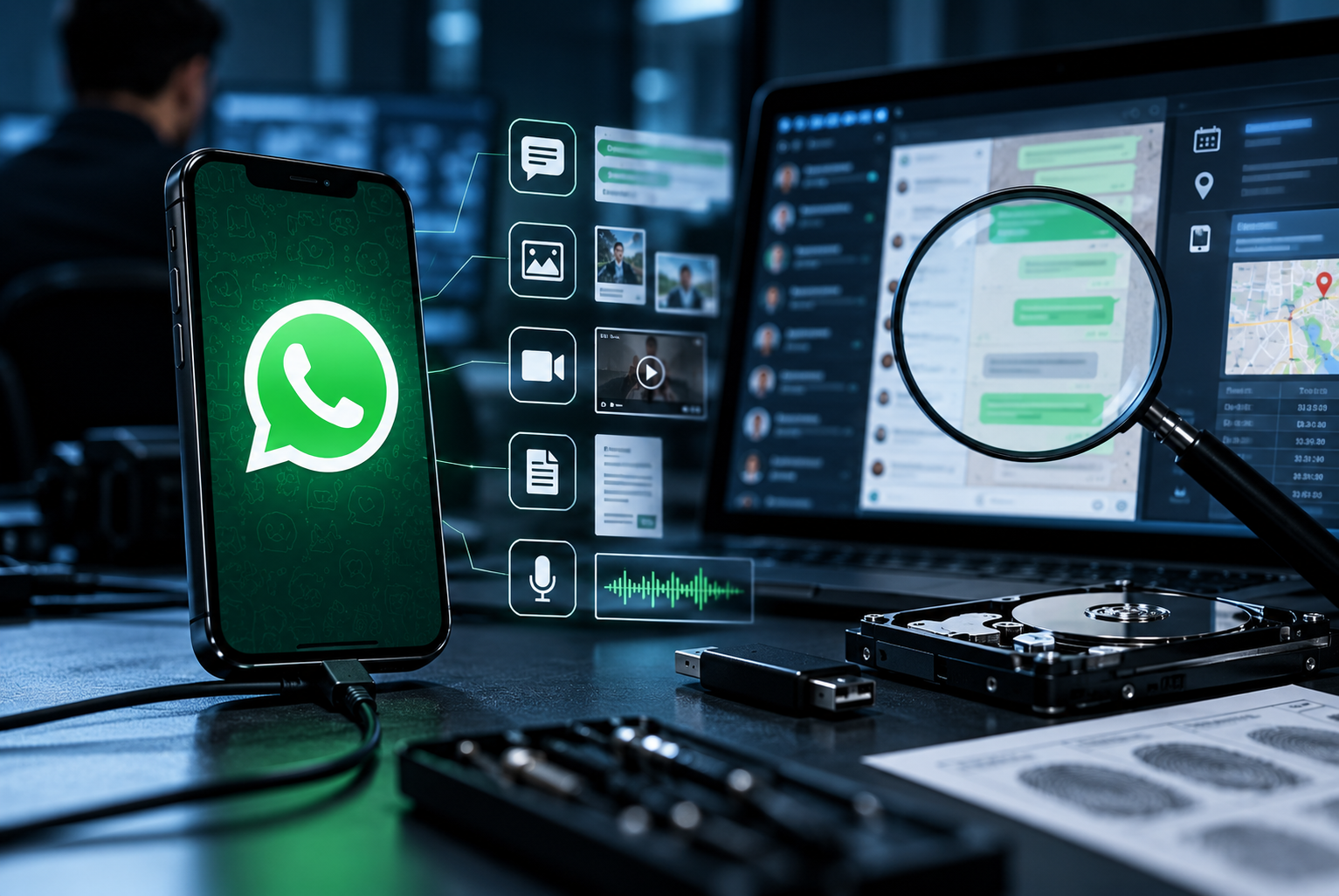
An employee resigns on a Friday. By Monday, a client list he handled has reached a competitor, and the only trace of how it travelled is a WhatsApp conversation he deleted before returning his phone. Everyone in the room assumes that chat is gone for good. Usually, it isn’t. That is the quiet reality of WhatsApp forensics: a conversation that looks erased to its owner often leaves footprints on the device, and a trained examiner knows where to look.
WhatsApp is now where quotations get approved, payments get promised and, unfortunately, where fraud gets planned. When a dispute reaches a boardroom or a courtroom, those chats are often the most honest record of what actually happened. The catch is that evidence like this is fragile. Handle it badly, and you lose it or make it inadmissible.
Why WhatsApp Evidence Carries So Much Weight
Email trails are formal and edited. WhatsApp chats are spontaneous, timestamped and full of context: voice notes, forwarded documents, location pins, group conversations where someone said the quiet part out loud. In corporate fraud, insider theft, harassment complaints and matrimonial or property disputes, this informality is what makes them valuable.
What most people don’t realise is that WhatsApp’s end-to-end encryption works against evidence retrieval from the company’s side. WhatsApp does not keep your message history on its servers, so there is no help desk to request it from. A proper WhatsApp forensic investigation therefore always goes back to the device, its backups, or a linked computer.
Where WhatsApp Data Actually Lives
Understanding the storage is half the job, because each location tells a different part of the story.
On Android
Chats sit in a SQLite database (commonly named msgstore.db) inside the app’s protected directory. Media files such as photos, voice notes and documents live in a separate folder and frequently survive even after the related chat is cleared. Accessing the protected database requires deeper extraction than simply plugging in the phone and copying files, and the depth depends on the device model, OS version, and lock status.
On iPhone
The equivalent database is typically ChatStorage.sqlite, stored in the app’s shared container. Access usually comes through a full file system extraction or a backup, and the method again depends on the iOS version and the device’s condition.
In backups and linked devices
Local backups, cloud backups, and WhatsApp Web sessions on a laptop can each hold data that the phone no longer does. Local backups are encrypted, so the key material matters; without it, a backup is little more than noise. In our experience, checking each of these sources often separates a partial answer from a complete one.
How WhatsApp Deleted Messages Recovery Works
Here’s where things get interesting. When a message is deleted, the database rarely scrubs the content immediately. SQLite often just marks that space as free, so fragments of the original text can sit in unallocated pages or write-ahead log files until the phone overwrites them. Examiners use specialised tools and manual carving to reconstruct those fragments and match them back to timestamps, senders and chat threads.
Other leftovers help too. Media files may remain in storage after the chat is gone. Notification records can preserve a message preview. Thumbnails, cached files and linked-device data can fill gaps the main database can’t.
Now the honest part. WhatsApp chat recovery is never guaranteed. The longer a phone stays in daily use after deletion, the more likely the old data is overwritten. A “Delete for everyone” action may leave only a placeholder behind. Any credible provider will tell you this upfront and explain what can and cannot be retrieved, instead of promising everything.
The Investigation Workflow, Step by Step
A sound WhatsApp data recovery process follows a disciplined order, because the sequence protects the evidence.
Isolate the device. The phone is cut off from networks so that no new messages arrive, no remote wipe is triggered, and nothing overwrites deleted content.
Acquire a forensic image. Investigators extract the data at the deepest level the device allows, and record a hash value (a digital fingerprint) of what was captured. If even one byte changes later, the hash no longer matches.
Parse and recover. The databases are decoded into readable chats, and deleted fragments are carved out and cross-checked against other artefacts on the device.
Build the timeline. Messages, calls, media and app activity are lined up chronologically, so the story emerges: who said what, when, and in what sequence.
Document everything. Record every action, tool, and finding in a report another expert could reproduce.
Making the Evidence Stand Up in Court
Recovering a message is one thing. Proving it is genuine is another. In India, electronic records are admitted with a certificate. Under the Bharatiya Sakshya Adhiniyam, Section 63 carries this forward from the old Section 65B of the Evidence Act, and the certificate should identify the device, describe how the record was produced, and include hash values, signed by the person in charge and an expert. This is why chain of custody, from the moment of seizure to the final report, matters as much as the recovery itself. A brilliant extraction with a broken custody trail can be challenged and weakened.
Mistakes That Quietly Destroy Evidence
A few patterns show up again and again:
- Scrolling through the chats “just to see” changes timestamps and can trigger sync or auto-clean actions.
- Reinstalling WhatsApp or restoring a backup can overwrite the very data you need.
- Taking screenshots and treating them as proof. Screenshots are easy to dispute and carry no metadata.
- Leaving the phone connected, where a remote wipe or automatic update can change its state.
If a device matters to a case, switch it to flight mode, power it down if instructed, and hand it to a specialist without altering it.
Choosing the Right Partner
Not every lab handles mobile evidence the same way. When evaluating Device Forensic Services in India, ask about their acquisition methods, how they document custody, whether their reports are court-ready, and whether their examiners have testified before. A reliable Digital Forensic Services Company in India will explain limitations plainly and will never pressure you into unrealistic expectations.
Final Thoughts
WhatsApp forensics rewards speed and restraint in equal measure. Act quickly, because overwriting is constant. Touch nothing, because every tap can alter the record. And bring in experts before the device is disturbed, not after. Deleted rarely means destroyed, but it does mean the clock is running.
If you are dealing with a suspected data leak, employee misconduct or a case where a phone may hold the answer, a conversation with the forensic specialists at Everence is a sensible first step before anyone opens that phone again.
Leave a Reply